Samples of Our Work
Each experience below was defined in close collaboration with our clients - starting from the real decisions, pressures, and learning constraints they faced. Rather than applying a fixed format, we selected game mechanics, scenario structures, and delivery modes that fit the circumstance: sometimes digital, sometimes analog, often both. Every experience was measured not by engagement alone, but by relevance to the learner, application to real-world decisions, and observable impact on organizational outcomes.
-
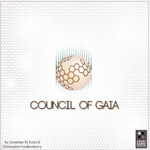
Council of GAIA is a strategic, semi-cooperative board game that places players in the role of global powers navigating climate change, energy policy, economic pressure, and political tradeoffs. Designed with data-informed mechanics and real-world event dynamics, the game forces players to balance short-term national interests against long-term planetary stability. Success depends on negotiation, systems thinking, and the ability to anticipate cascading consequences. Used with policymakers, students, and organizational leaders, Council of GAIA transforms abstract climate complexity into lived experience- revealing how well-intentioned decisions can still drive systemic failure if coordination and timing break down.
“What surprised us wasn’t how competitive the game became it was how quickly players saw the unintended consequences of rational decisions. Council of GAIA made climate complexity impossible to ignore and impossible to oversimplify.”
- Policy Advisor, Climate & Energy Initiative
-
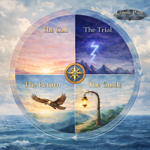
The Cosmic Lens is an experiential learning system designed to help participants explore complex systems through perspective-shifting scenarios. Combining facilitated dialogue, narrative framing, and interactive decision moments, the experience invites learners to examine how worldview, assumptions, and scale influence judgment. Rather than optimizing for correct answers,
The Cosmic Lens develops the capacity to see patterns across time, roles, and systems. Used in leadership development, education, and community contexts, it strengthens reflective thinking, ethical reasoning, and the ability to navigate uncertainty - skills essential for decision-making in interconnected and rapidly changing environments.
“Participants stopped arguing about solutions and started examining how their assumptions shaped the system. That shift—from position to perspective-was the real learning.”
-Director, Leadership & Systems Education Program
“What surprised us wasn’t how competitive the game became it was how quickly players saw the unintended consequences of rational decisions. Council of GAIA made climate complexity impossible to ignore and impossible to oversimplify.”
- Policy Advisor, Climate & Energy Initiative
-
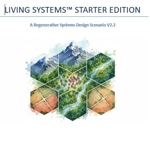
The Living System is a cooperative simulation focused on regenerative thinking across land use, food systems, water, energy, and community wellbeing. Players steward interconnected resources while responding to environmental shocks, growth pressures, and collective tradeoffs. Designed as an analog-first experience with facilitated reflection, the game makes visible how local actions propagate across systems. It is frequently used to support conversations about sustainability, regeneration, and long-term stewardship. Learning is measured through participants’ ability to articulate system feedback loops, anticipate unintended consequences, and apply regenerative principles to real-world planning and collaboration.
“The game made regeneration tangible. People could see how small decisions in one area created ripple effects elsewhere. It changed how our teams talk about stewardship and long-term impact.”
-Program Lead, Sustainability & Community Development
-
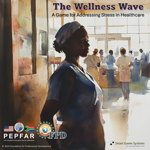
The Wellness Wave was developed with healthcare professionals to address burnout, workload pressure, and systemic stress in clinical environments. This cooperative board game places players inside realistic workplace scenarios where staffing, communication, policy constraints, and patient care demands collide. Rather than individual resilience alone, the game emphasizes systemic contributors to burnout and collective problem-solving. Participants explore how smalldecisions compound stress - or relieve it across teams. The experience is measured by increased empathy, improved dialogue about system design, and practical insights that inform organizational interventions to improve staff wellbeing and care quality.
“For the first time, staff felt safe naming the systemic pressures that drive burnout. The game helped us move beyond‘self-care’ and toward real organizational conversations.”
- Hospital Administrator, Workforce Wellbeing
The Cosmic Lens develops the capacity to see patterns across time, roles, and systems. Used in leadership development, education, and community contexts, it strengthens reflective thinking, ethical reasoning, and the ability to navigate uncertainty - skills essential for decision-making in interconnected and rapidly changing environments.
“Participants stopped arguing about solutions and started examining how their assumptions shaped the system. That shift—from position to perspective-was the real learning.”
-Director, Leadership & Systems Education Program
“What surprised us wasn’t how competitive the game became it was how quickly players saw the unintended consequences of rational decisions. Council of GAIA made climate complexity impossible to ignore and impossible to oversimplify.”
- Policy Advisor, Climate & Energy Initiative

-
The Next Wave was developed as an onboarding simulation for thousands of new hires at Nike. The objective was not to teach brand knowledge, but to prepare employees to make good decisions in a fast-moving, values-driven environment. Through scenario-based gameplay, participants practiced judgment, collaboration, and cultural alignment under realistic conditions. Game mechanics emphasized tradeoffs, pace, and consequence rather than correctness.
Impact was measured through confidence, decision readiness, and alignment with Nike’s operating culture-helping new hires transition from understanding expectations to living them in real work contexts.
“New hires didn’t just learn what Nike values-they practiced making decisions the Nike way. That accelerated readiness far more than traditional onboarding ever did.”
- Global Onboarding Lead, Nike
“What surprised us wasn’t how competitive the game became it was how quickly players saw the unintended consequences of rational decisions. Council of GAIA made climate complexity impossible to ignore and impossible to oversimplify.”
- Policy Advisor, Climate & Energy Initiative

-
Maternity Clinic is a scenario-based training simulation designed for healthcare providers working in maternal and neonatal care. Players navigate clinical, operational, and communication challenges common in under-resourced settings. Decisions affect patient outcomes, staff coordination, and clinic flow. The simulation emphasizes situational awareness, prioritization, and teamwork under pressure. Used in professional training contexts, the experience supports safer clinical practice by allowing practitioners to rehearse critical decisions before facing them in real life. Learning outcomes are measured through improved clinical judgment and team communication.
“Clinicians appreciated being able to rehearse difficult decisions without patient risk. The scenarios reflected real constraints, not ideal conditions.”
- Clinical Training Lead, Maternal Health Program
This scenario can be adapted for the planning and management of any facility that has a diverse team of professionals that must work harmoniously together to maximize success and minimize catastrophic consequences. Key outcome is no loss of life and high level of cooperation between practitioners.
-
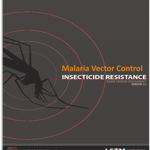
The Malaria Vector Control simulation was developed to support public health education in sub-Saharan Africa. Combining digital gameplay with facilitated discussion, the experience places learners in the role of decision -makers responsible for reducing malaria transmission under real-world constraints. Players must allocate resources, select intervention strategies, and respond to environmental and behavioral variables. The simulation emphasizes systems thinking - revealing how prevention, treatment, education, and infrastructure interact. Impact was measured through improved understanding of vector dynamics and increased effectiveness of community - level prevention strategies.
“The simulation helped participants understand why single interventions fail. They began coordinating strategies instead of treating malaria as a one-dimensional problem.”
-Public Health Program Manager,Sub-Saharan Africa
This scenario can be adapted for the planning and management of any use of pesticide or medicine requiring access to on-the-ground information and scientific data. Key outcome is reduced morbidity of population and mitigation of resistance to treatment.
“What surprised us wasn’t how competitive the game became it was how quickly players saw the unintended consequences of rational decisions. Council of GAIA made climate complexity impossible to ignore and impossible to oversimplify.”
- Policy Advisor, Climate & Energy Initiative

-
Mission to Mars: An Agile Adventure is a simulation designed to teach Agile principles through lived experience rather than instruction. Teams must collaborate to complete a high-stakes mission while managing uncertainty, limited resources, shifting requirements, and stakeholder pressure. Agile values—iteration, transparency, adaptation - emerge as necessities, not concepts. Used with software teams, leaders, and transformation initiatives, the experience makes visible how organizational habits either enable or undermine agility. Learning transfer is measured through changes in team behavior, improved retrospectives, and more effective application of Agile practices on real projects.
“Teams finally understood Agile because they felt the cost of not being Agile. The behaviors emerged naturally under pressure - it didn’t feel like training.”
- Transformation Coach, Enterprise Technology Group
This scenario can be adapted for the planning and management of any project that requires a diverse team of professionals working together to create an MVP for a demanding client with limited time and resources such as Lean Management. Key outcome is the core elements of a project completed with additional requirements to meet customer needs.
-
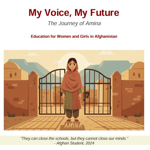
My Future, My Choice: The Story of Layla is a narrative-driven interactive experience designed for youth education. Players follow Amina of Kabul Afghanistan as she navigates life decisions related to education and personal agency. Choices shape the story’s direction, revealing how small decisions compound over time. Designed to be emotionally engaging and culturally relevant, the experience encourages reflection without prescribing outcomes. Impact is measured through learner engagement, self-reported insight, and increased confidence in decision-making - helping young people connect present choices to future possibilities.
“Students stayed engaged because the story felt real. They could see how small choices added up - and that made reflection personal, not abstract.”
Youth Program Coordinator, Education NGO
“The simulation helped participants understand why single interventions fail. They began coordinating strategies instead of treating malaria as a one-dimensional problem.”
-Public Health Program Manager,Sub-Saharan Africa
This scenario can be adapted for the planning and management of any use of pesticide or medicine requiring access to on-the-ground information and scientific data. Key outcome is reduced morbidity of population and mitigation of resistance to treatment.
“What surprised us wasn’t how competitive the game became it was how quickly players saw the unintended consequences of rational decisions. Council of GAIA made climate complexity impossible to ignore and impossible to oversimplify.”
- Policy Advisor, Climate & Energy Initiative